
Finishing Strong as a Leader Why Discipline, Mindset, and Identity Matter More Than Timing

Free Training for Entrepreneurs and Leaders
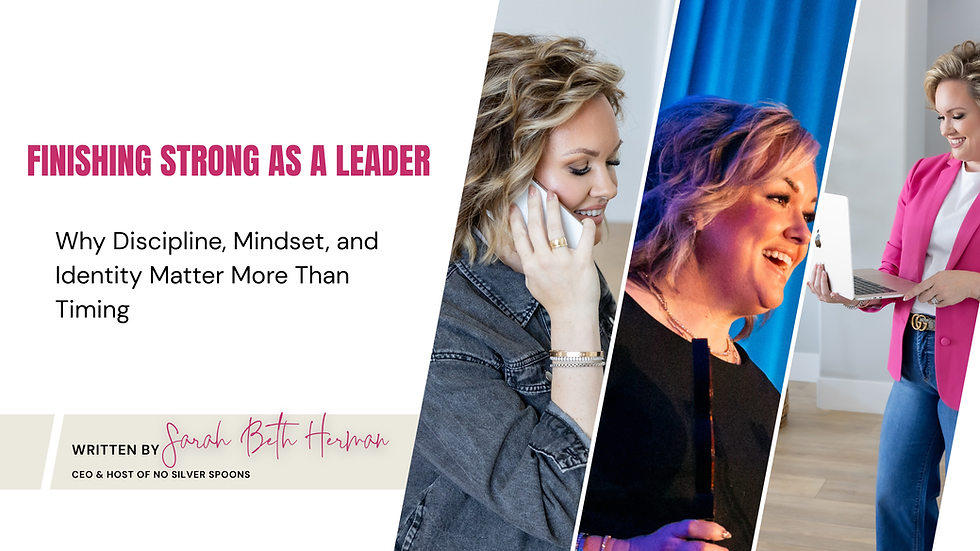
Finishing strong is not about motivation. It is about identity. Entrepreneurs and leaders often believe that success comes from pushing harder, moving faster, and doing more. But the truth is this. Most growth is not lost because of lack of effort. It is lost because of exhaustion, misalignment, and unfinished decisions.
This free training was created for entrepreneurs, business owners, executives, and leaders who are building something meaningful and feel the weight of that responsibility. It is designed to help you understand why finishing strong is not tied to a season, a calendar, or a burst of energy. It is tied to who you are becoming and how you think when things feel heavy.
This training serves as a precursor to the upcoming episode of No Silver Spoons, releasing Monday, and will help you listen with clarity, context, and intention.
Why Entrepreneurs Struggle to Finish Strong
Entrepreneurs do not usually quit because they are incapable. They slow down because they are tired. Leadership fatigue is real, especially for those carrying vision, people, finances, and long-term responsibility. When pressure builds, the mind looks for relief, not resolution.
This is when leaders begin to:
Delay hard conversations
Postpone strategic decisions
Push tasks into “next month”
Avoid reviewing uncomfortable numbers
Mentally disengage while still showing up physically
Finishing strong becomes harder not because the work is impossible, but because the emotional cost feels high. But avoiding completion always costs more later.
Finishing Strong Is Not a Calendar Skill, It Is a Character Skill
One of the most common misconceptions in leadership is that finishing strong is about timing.
It is not. Finishing strong is about discipline. Discipline is not punishment. It is protection.
When leaders finish what they start, they build internal trust. When leaders avoid completion, they quietly train themselves to doubt their own follow-through. Over time, this erodes confidence.
Strong leaders understand that discipline is not about doing everything perfectly. It is about closing loops, honoring commitments, and respecting the future version of themselves.
Leadership Fatigue and the Weight of Responsibility
Entrepreneurs often carry responsibilities that no one else sees.
You are the one thinking about:
Payroll
Client retention
Market changes
Team morale
Long-term vision
Risk management
This level of responsibility creates mental strain.
Leadership fatigue often shows up as:
Emotional numbness
Irritability
Decision paralysis
Loss of joy
Desire to withdraw
This does not mean something is wrong with you. It means your nervous system is tired.
Understanding this is essential to finishing strong without burning out.
The Role of Mindset in Sustainable Leadership
Mindset is not positive thinking. Mindset is the framework through which you interpret pressure, setbacks, and growth. Leaders who operate from a regulated, grounded mindset:
Respond instead of react
Solve problems faster
Maintain perspective during stress
Stay aligned with long-term vision
Leaders who operate from exhaustion-driven thinking:
Personalize setbacks
Spiral under pressure
Make reactive decisions
Avoid uncomfortable tasks
The difference is not intelligence. It is mental conditioning.
Neuroplasticity and Leadership Growth
Neuroplasticity is the brain’s ability to change based on repeated thoughts, behaviors, and experiences. For leaders, this is critical. Your brain strengthens what you practice.
If you repeatedly think:
“This always falls on me”
“I am behind”
“This is too much”
Your brain begins to treat stress as the default state.
Over time, leadership feels heavier than it needs to be.
The powerful truth is this. Those patterns are learned, not permanent.
Through neuroplasticity, leaders can retrain their minds to:
Expect solutions
Stay grounded during uncertainty
Create emotional safety while growing
Maintain clarity under pressure
This is not about ignoring challenges. It is about meeting them with stability.
Setbacks Are Not Stop Signs, They Are Instruction
Every entrepreneur experiences setbacks. Lost revenue. Client issues. Broken partnerships. Unexpected obstacles. What determines long-term success is not the absence of setbacks, but the response to them.
Research in cognitive reframing shows that leaders who choose purposeful responses recover emotionally faster and identify solutions more efficiently (Gross, 2015).
Purposeful response looks like:
Pausing before reacting
Gathering facts
Trusting systems and process
Staying ethical even when disappointed
Setbacks are not punishment. They are refinement.
Integrity as a Leadership Advantage
Integrity is often talked about but rarely tested in comfortable seasons.
It is tested when:
Things feel unfair
Effort is not immediately rewarded
Others do not operate with the same values
Leaders who stay consistent in their integrity build long-term credibility. Even when results take time. Integrity compounds. It builds trust with clients, teams, partners, and yourself.
Finishing Strong Protects the Leader You Are Becoming
Unfinished work creates mental clutter. Unresolved decisions create emotional weight.
When leaders carry too many open loops, burnout follows. Finishing strong:
Reduces mental load
Builds confidence
Creates momentum
Strengthens identity
Completion is not about exhaustion. It is about clarity.
A Practical Free Training Exercise for Leaders
This training includes a simple, powerful exercise. Create a Finish Strong List. Three columns.
Column One: What must be finished in this season
Column Two: How it will be finished
Column Three: How completion will be measured
This exercise helps leaders move from overwhelm to action.
It turns pressure into structure.
Preparing for the Podcast Episode
This free training is meant to prepare you for the upcoming episode of No Silver Spoons.
The episode expands on:
Leadership fatigue
Discipline versus comfort
Setbacks and mindset
Finishing strong without burnout
Becoming the leader your future self will thank
Reading this first allows you to listen more intentionally.
Key Takeaways from This Free Training
Finishing strong is about identity, not timing
Leadership fatigue is a nervous system response, not failure
Mindset shapes how leaders experience pressure
Neuroplasticity allows leaders to retrain thought patterns
Integrity compounds over time
Completion builds confidence and clarity
Final Thoughts for Entrepreneurs and Leaders
You do not need to become someone else to grow.
You need to honor who you are becoming.
Finishing strong is not about pushing harder. It is about showing up with intention, discipline, and trust in the long-term process.
This is how sustainable leadership is built.
References
Gross, J. J. (2015). Emotion regulation: Current status and future prospects. Psychological Inquiry, 26(1), 1–26. https://doi.org/10.1080/1047840X.2014.940781
Siegel, D. J. (2020). The developing mind: How relationships and the brain interact to shape who we are (3rd ed.). Guilford Press.
Dweck, C. S. (2016). Mindset: The new psychology of success. Random House.
World Health Organization. (2022). Mental health at work: Policy brief. WHO Press.

Disclaimer: The information provided in this blog is for informational purposes only and does not constitute professional advice. Readers should consult with appropriate professionals for specific advice tailored to their circumstances. All efforts have been made to ensure the accuracy of information and references; however, errors may occur. If you notice any inaccuracies or would like to suggest updates, please contact us at hey@sarahbethherman.com. © 2025 Sarah Beth Herman. All Rights Reserved. By using this site, you agree to our Privacy Policy and Terms of Use. This post may contain affiliate links, and we may earn a commission at no extra cost to you if you make a purchase through them. References included where known. Please email hey@sarahbethherman.com



Comments